
The job
In August 2023, through a main contractor, we were engaged to supply, install, test and commission a thermal screening station at the CIQ checkpoint in Johor Bahru — one of Malaysia’s designated international points of entry (pintu masuk antarabangsa), and the health-screening infrastructure that outlived the pandemic emergency at the border. The station: a FLIR E76 radiometric camera on a tripod — the specification called for “a FLIR E75 or its equivalents,” and by delivery the E75 had been discontinued, so the newer E76 went in — with a 32-inch operator monitor and FLIR’s screening software, commissioned in early October 2023 with operator training, a two-year preventive-maintenance arrangement, and annual calibration of the site’s three-camera fleet.
One attribution note, stated plainly: this work was delivered under AMKA Tech Solutions, the partnership that preceded AMKA Technologies Sdn Bhd — by the same people, with a certified Level 2 thermographer partnered alongside our own certified thermographer.
The standard was the easy part
Fever screening by thermal camera has a proper methodology, and it is demanding: measure only the inner canthus of the eye — the small region beside the tear duct, the most stable external proxy for core temperature — emissivity set to 0.98, one subject at a time, a controlled non-reflective background, thirty minutes of camera warm-up, no glasses, no caps, a fixed measurement geometry. Our commissioning checklist carried all of it, and our testing report opened with a sentence we would still sign today: “the system does not detect fever, bacteria, viruses, or diseases — it captures emitted infrared energy.”
The uncomfortable context is that mass screening deployments worldwide routinely ignored that methodology — the research literature said so at the time, in papers with titles like “Infrared thermography for mass fever screening: repeating the mistakes of the past.” Following the standard was not the industry norm. It was a choice — and it is where the actual engineering began, because the standard tells you what a correct measurement looks like, and a live border hall tells you what is actually possible. The lessons below are what the gap taught us.
Lesson one — absolute numbers don't survive the field
The naive design alarms at an absolute threshold: anyone above, say, 37.5°C. In a border hall it fails immediately: ambient drifts through the day, humidity swings, skin temperature varies person to person and hour to hour, and every instrument carries drift of its own. Chasing absolute accuracy in that environment is not difficult — it is dishonest.
The defensible method, built into the screening software and into our commissioning, is relative: continuously sample the measured temperatures of the arriving population, hold a rolling average, and alarm on deviation above that baseline. The threshold we set was one degree above the running average: read more than 1 °C hotter than the people arriving around you and you became a suspect — deliberately that word, and never “a case”: a reason for a proper clinical measurement, not a conclusion. The alarm then means the one thing the physics actually supports: this person is measurably warmer than the people around them, right now, under the same conditions.
And the reference itself ages. Ambient climbs through a Malaysian morning, air conditioning cycles, the sun works its way across the hall — so re-sampling the baseline is not a commissioning step that finishes, it is a standing operator duty through the shift. A reference nobody maintains quietly stops being a reference; part of training the operators was training them to notice when the average no longer described the room.
So we brought our own instruments to the commissioning — two of them, doing nothing but recording the environment the screening ran in. One logged relative humidity. The other measured air movement and ambient temperature. Neither was in the quotation and neither formed part of the delivered station.
Air movement is the one people forget. Somebody standing in the draught from an air-conditioning vent loses heat from the skin faster than the person beside them, and reads cooler for a reason that has nothing whatever to do with their health — while a queue stalled in still air reads warmer. Humidity and ambient move the readings too, and all three drift through a border-hall morning. Recording them is what lets a number be checked afterwards, which is the same reason an electrical survey report carries ambient, load and working distance beside every finding. A temperature without its conditions cannot be verified by anyone — including the person who took it.
Lesson two — distance changes the reading
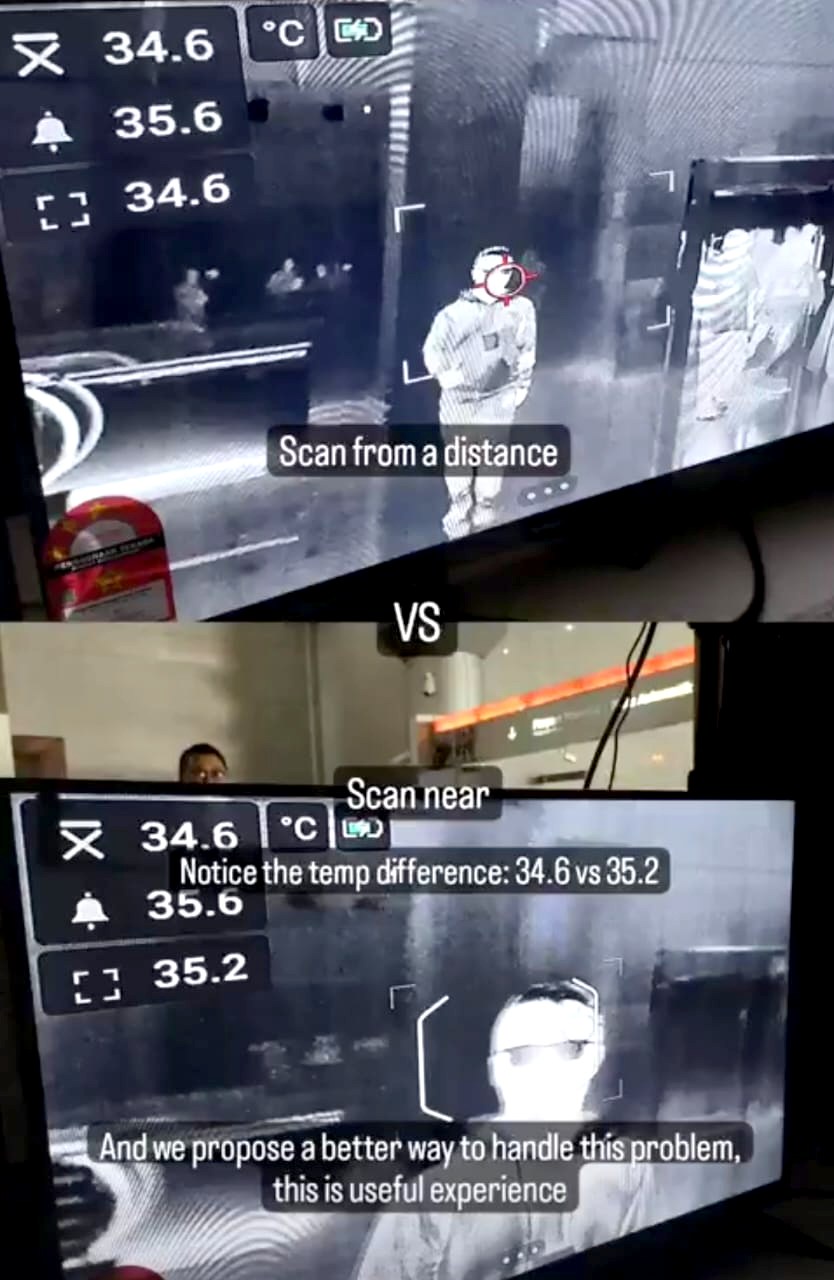
During testing we could watch a subject’s reading rise as they approached the camera — not because they warmed up, but because the measurement got truer. The inner canthus is a tiny target: at distance it under-fills the camera’s measurement spot, so the reading averages in cooler cheek and background and comes out low. Every meter of air absorbs a little more infrared on top.
The consequence became commissioning procedure: fix the working distance first, put a person on that mark, sample the baseline at that distance — and only then screen. A threshold sampled at two meters is simply wrong at four. Anyone who has scoped an electrical survey will recognise this as distance-to-spot discipline; a fever queue enforces it more strictly than any switchroom.
Lesson three — the camera tracks, the operator interprets
The screening software tracks continuously, even at range — and it does not need a frontal face. It holds onto heads, and since people walking past present side profiles, most of the stream was sampled exactly that way: head and profile, not the textbook inner canthus. That is a deviation from the posed ideal, and it is honest to say so — and it is also precisely why the relative method holds: fair comparison needs like against like, not the perfect target. Everyone sampled as a passing profile, everyone compared as a passing profile; the frontal, canthus-true measurement belonged to the posed verification at the mark.
This is also what makes relative measurement survive real-world throughput. A rolling baseline needs constant feeding, and no border on earth can ask its queue to stop and pose — because the tracker holds each passing head long enough to register it, the baseline samples itself from the walking stream. For the record, we did propose the better geometry: repositioning the camera to face the approach lines head-on, so the stream itself would present frontal targets. The site preferred not to alter the flow — at a checkpoint moving this many people, layout stability is a legitimate priority that outranks measurement elegance, and it was their call to make. The engineering answer is the method above: adapt the measurement so it stays honest inside the constraint, and write the constraint down. A commissioning that only works when the site rearranges itself for the instrument is not a commissioning.
The long-range view earned its keep a second way: context. From distance, the operator can see a person who is hurrying — visibly hotter at the head and neck from plain exertion — long before they reach the mark. The number cannot tell exertion from fever. The operator, watching the approach, can. That division of labour became the lesson: automate the pointing, never the judgement. A screening station without a trained operator is a camera with opinions.
Lesson four — it isn't a thermometer, and saying so is the product
Put the lessons together and the honest conclusion writes itself: a thermal screening station is not a thermometer. It is a triage instrument. Its output is never “this person is 37.8°C” — it is “this person reads warmer than the population, at this distance, under these conditions: confirm properly.” The confirming instrument — a clinical thermometer, on the few who alarm — does the absolute measurement the camera honestly cannot.
Screen everything relatively; measure the flagged few absolutely. If that sounds familiar, it is because it is how we rate switchboards today: a thermal survey rates a joint by its rise against the neighbouring phase, under recorded load, at a known distance — never by an absolute number read off a screen.
And here is the uncomfortable part: fever screening’s mistakes are being quietly repeated in maintenance rooms. The pandemic put a thermal camera within every budget, and plenty of facilities bought one, pointed it at their panels, read the absolute temperatures off the display — no reference, no load recorded, no distance discipline — and concluded they were covered. That is checkpoint theatre with a different subject. The camera was never the capability; the method is, and everything in this article is what the method actually costs. A facility camera is genuinely useful in trained hands between proper surveys — we have written about what belongs in-house and what does not — but owning one is not a condition-monitoring programme, any more than owning a camera made anyone a fever screener. The two-stage logic we publish for switchboards was stress-tested first on people, at a checkpoint that processes more subjects in a day than most facilities own assets.
The instrument floor — why cheap thermal was never an option
Every lesson above quietly prices the camera. Putting enough pixels on a target the size of a tear duct, at a fixed working distance, takes genuine detector resolution — below it, the spot averages in background no matter how careful the operator is. The population-baseline alarming is measurement firmware, not an app feature — budget imagers and phone dongles have nothing like it. Radiometric stability is what makes a rolling baseline meaningful at hour six of a shift. And the contract required annual certified calibration of the fleet — a cheap camera cannot be traceably calibrated at all, which quietly disqualifies its readings from any file an insurer, auditor or regulator will lean on.
The same floor exists in industrial work, for the same physics: a small terminal at the back of a switchboard is the inner canthus of the electrical world. Our published position stays balanced — past the instrument floor, survey design and the person behind the lens move results far more than the spec sheet — but the floor is real, and below it the instrument disqualifies itself before skill enters the conversation. A cheap camera cannot reach the floor; an expensive one does not excuse the operator.
What we carry from it
The station was commissioned, the operators trained, the calibration cycle set — and the measurement lessons outlived the job. When our survey reports record the load, the working distance, and the comparison basis; when our screening pages state plainly what an instrument can and cannot conclude — that discipline has a traceable origin, and part of it is a border hall in Johor, October 2023.
Retrieved from https://amkatechnologies.com/insights/case-study-fever-screening-johor
Published 31 July 2026. AMKA Technologies Sdn Bhd, SSM 202301041763 (1535682-T).